

Inside Saudi Arabia’s Most Beautiful Villages – And the Stories They Carry
Beyond the gleaming towers of Riyadh and sacred mosques of Makkah, Saudi Arabia is a land rooted in ancient history. While the country is developing astonishingly fast, deeper in the mountains lie a number of villages that speak to an older, more elemental way of Saudi life. Built from the land itself – in stone, clay, or sun-dried brick – these extraordinary settlements are largely untouched, preserving centuries of local knowledge and regional identity. Below, we explore five of the Kingdom’s most captivating villages, from the stacked stone homes of Rijal Almaa in the southwestern highlands to the fortified mudbrick palaces of Diriyah near the capital.
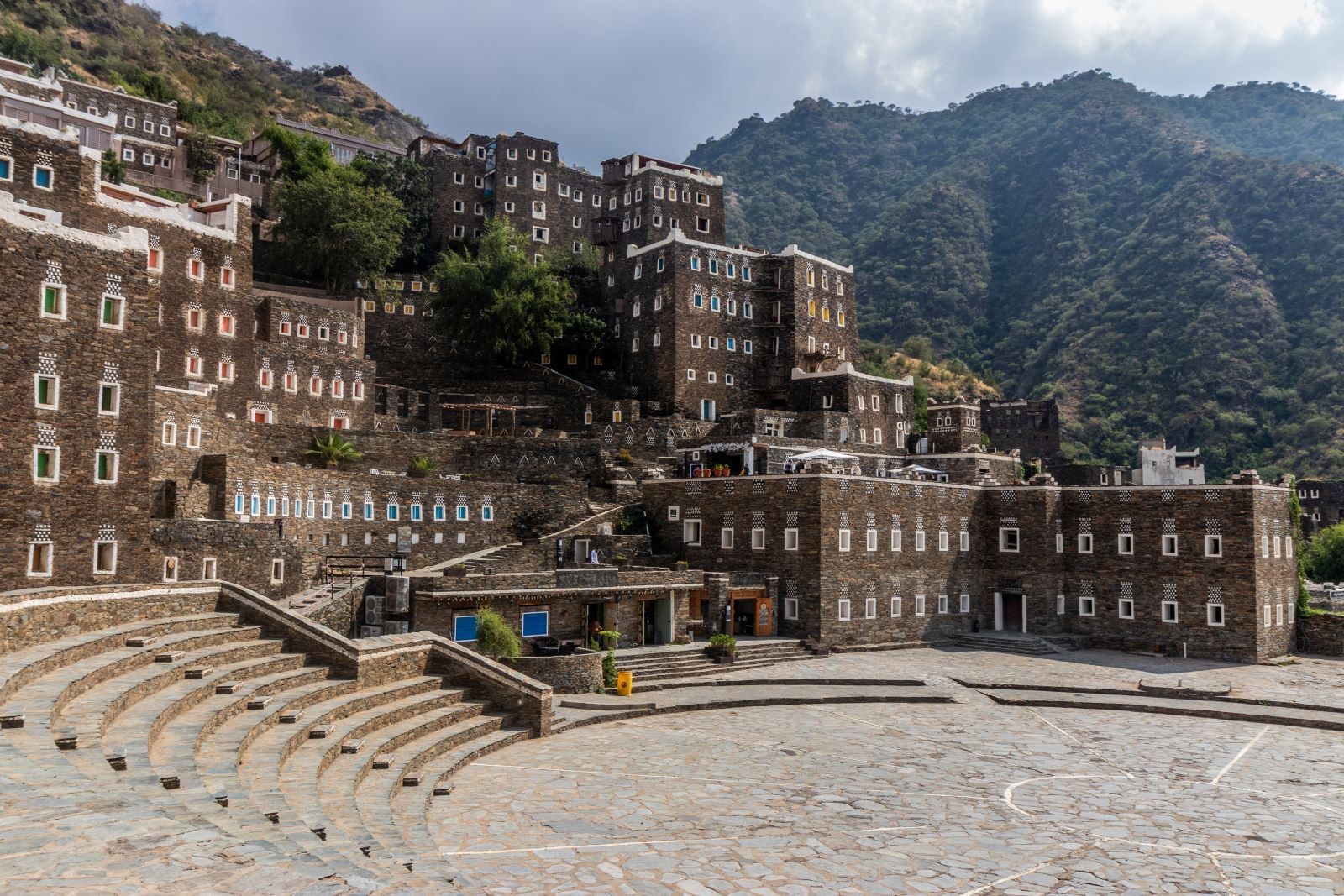
1. Rijal Almaa – The Mountain Village of Stone and Colour
When most people picture Saudi Arabia, flame-licked sands and imposing Islamic architecture often come to mind. But at the foot of the Sarawat Mountains in the southwest, Rijal Almaa shows a different face. Built from dark slate and tucked into a green valley near Abha, the village is almost alpine in appearance – misty and otherworldly in the heart of the verdant Asir Province.
Rijal Almaa has stood for over nine centuries. Once a key stop for merchants and pilgrims moving between the Red Sea and the highlands, it grew into a fortified settlement with unusually tall homes – some rising eight storeys. The windows and doors are bordered with geometric motifs painted in a local style known as qut, traditionally created by Asiri women. The effect is subtle but highly expressive – a vernacular art form that continues today. Much like modern Saudi homes, the interiors typically include a central majlis, built with thick walls to regulate the mountain air.
In 1985, the village opened one of Saudi Arabia’s first local museums, housed in a former fort and filled with manuscripts, tools, and tribal artefacts. More recently, Rijal Almaa was nominated for UNESCO World Heritage status and has become a model for responsible tourism in the south. Still partially inhabited, it offers one of the clearest views into the architectural traditions and cultural history of Asir.
2. Thee Ain – The ‘Marble Village’ of the Mountains
Tucked into the cliffs of Al-Baha Province, Thee Ain is one of Saudi Arabia’s most visually striking villages. Its angular stone buildings are set on a natural rocky outcrop at the edge of a spring-fed valley, framed by date palms and the jagged peaks of the Hejaz. At sunrise, the entire village takes on a silvery glow, earning it the nickname ‘the marble village’.
Thee Ain was founded over four centuries ago, named after the Ain spring that still runs through the area, irrigating the terraced farms and orchards below. The homes are built from locally quarried stone, with clean, rectangular forms rising two to four storeys high. Narrow lanes thread between them, leading to shaded courtyards, stepped terraces, and lookout points once used to monitor passing caravans.
Though the village has been uninhabited for several decades, Thee Ain has undergone careful restoration and is now open to visitors. The original layout remains intact, and efforts have been made to preserve its dry-stone walls and agricultural channels.
3. Diriyah – The Historic ‘City of Earth’
Just outside Riyadh lies the storied city of Diriyah: the ancestral seat of the Al Saud family and the birthplace of the First Saudi State. Founded in the 15th century, Diriyah was once a key political territory, with the fortified mudbrick district of At-Turaif at its heart. Now a recognised UNESCO World Heritage Site, the area includes mosques, museums, and Salwa Palace – a commanding structure that once housed the royal court.
Today, Diriyah is the focus of an ambitious heritage-led masterplan by Diriyah Company. While the original town is undergoing careful restoration, the surrounding area is being redeveloped into a bustling cultural and residential centre, paying tribute to the landscape with earthen mudbrick facades, Najdi motifs and contemporary Saudi interior design.
In February 2025, Diriyah also hosted Sotheby’s inaugural auction in the Kingdom – a milestone that reflects its growing status as a locus of art, heritage, and high culture.
4. Ushaiqer – A Desert Stronghold in the Heart of Najd
Set along the old pilgrimage route to Makkah, Ushaiqer is one of the oldest mudbrick settlements in the Najd region. Surrounded by desert and palm groves, the village offered shelter to traders, travellers, and tribal families long before the rise of Riyadh. Its name, meaning ‘Little Blonde’, refers to the pale-red mountain nearby – a landmark once used to guide those crossing the central plateau.
Unlike the stone-built villages of Thee Ain and Rijal Almaa, Ushaiqer is shaped by the sand. Homes are constructed from sun-dried mudbrick, coated in smooth clay and supported by traditional tamarisk wooden beams. In the 17th century, Ushaiqer emerged as a centre of learning and religious life, home to several prominent tribes and scholars, including the Banu Tamim and the Al Sheikh family. Many of its original inhabitants have since moved to nearby towns, but the village has been extensively restored, with more than 400 buildings preserved and a dedicated heritage centre in place.
Visitors can now walk through its labyrinthine corridors, mosques, majlis, watchtowers, and traditional markets. Though the desert has crept closer, Ushaiqer remains deeply intact – a rare example of Najdi architecture preserved at scale.
5. Habala – The Cliffside Village of ‘Flower Men’
Habala is undoubtedly Saudi Arabia’s most unique village, built on the sharp edge of a cliff high up in the Sarawat Mountains, more than two thousand metres above sea level. For much of its history, the only way in or out was by rope ladder (the word habala itself comes from habl, meaning rope in Arabic). Cut off from surrounding settlements, the village was once home to a small Qahtan community, often referred to as the ‘flower men’, known for their long-standing tradition of wearing garlands of fresh herbs and blooms.
The stone houses are modest and irregular, built along narrow ledges with small terraces for drying crops and storing water. Farming took place on sloped plots nearby, sustained by rain and seasonal springs. Oral histories suggest the extreme location offered protection from Ottoman persecution in the 19th century, allowing families to remain hidden among the rocks.
In the 1990s, Habala was reopened via cable car, giving visitors access to what had long been an isolated world. While the original residents have mostly relocated, their descendants still return for festivals and summer gatherings, and elements of their dress and music remain part of the cultural identity of Asir.
Read More