

Jeddah Reimagined: A City of Substance Enters Its Next Chapter
Some cities do not need to announce themselves, with reputations that have been built across centuries and are woven into the fabric of history. Jeddah is precisely that kind of city. It has long been established as Saudi Arabia’s main port and coastal gateway, serving as a centre for trade, commerce and culture. From the outside, it may seem as if Jeddah is experiencing a renaissance with the scope and scale of developments that are taking place across the city and its surrounding province, but this is more of a refinement than a reinvention. And for investors with a long-term perspective, this historic city is fast becoming one of the most compelling real estate propositions in the Middle East.
A Foundation Built on More Than Ambition
To understand Jeddah, one must first understand its character. Unlike many of the Gulf's newer urban projects, which are being constructed from the ground up with an identity still to be earned, Jeddah's credentials are organic. For centuries, the city served as the primary sea gateway to Makkah, positioning it as a meeting point for peoples, cultures and commerce from across the Islamic world and beyond. That heritage informs how the city moves, how it feels and, more critically, how it holds value.
Today, Jeddah is Saudi Arabia's second-largest city and its principal western gateway, home to a population of over four million and anchored by a commercial ecosystem that spans aviation, banking, healthcare and retail. The Islamic Development Bank, Savola Group, Bupa Arabia and the expansive Saudia and Saudia Technic operations centred around King Abdulaziz International Airport all contribute to a city with genuine economic weight. For investors who require more than a lifestyle story to justify a long-term commitment, this balance-sheet substance matters considerably.
The Transformation Now Under Way
What elevates Jeddah's current proposition from interesting to exceptional is the scale of structured transformation now reshaping the city's urban fabric. The headline development is Jeddah Central, a landmark waterfront district backed by the Public Investment Fund through Jeddah Central Development Company. Spanning approximately 5.7 million square metres, the project features a 9.5-kilometre waterfront, a 2.1-kilometre sandy beach, around 17,000 residential units and 2,700 hotel rooms, alongside an opera house, museum, sports stadium and oceanarium. The first phase is targeted for completion by the end of 2027.
To frame this as simply a large-scale project would be to miss its significance. Jeddah Central is a repositioning of the city's identity and a deliberate act of urban authorship that will reshape how Jeddah is perceived domestically and internationally for decades to come. For investors, that translates directly into long-term capital appreciation in the surrounding residential and mixed-use market.
Alongside this is Jeddah Tower, which is expected to take the crown from Dubai’s iconic Burj Khalifa as the world's tallest building when complete, and the wider Jeddah Economic City development. All of these projects reinforce the city's skyline ambition and its capacity to attract significant institutional capital.
A Coastal City in Full Expression
For the international buyer considering a second home, a legacy holding or a lifestyle-led primary residence, the quality of daily life matters as much as the yield projection. And on that measure, Jeddah delivers with considerable ease.
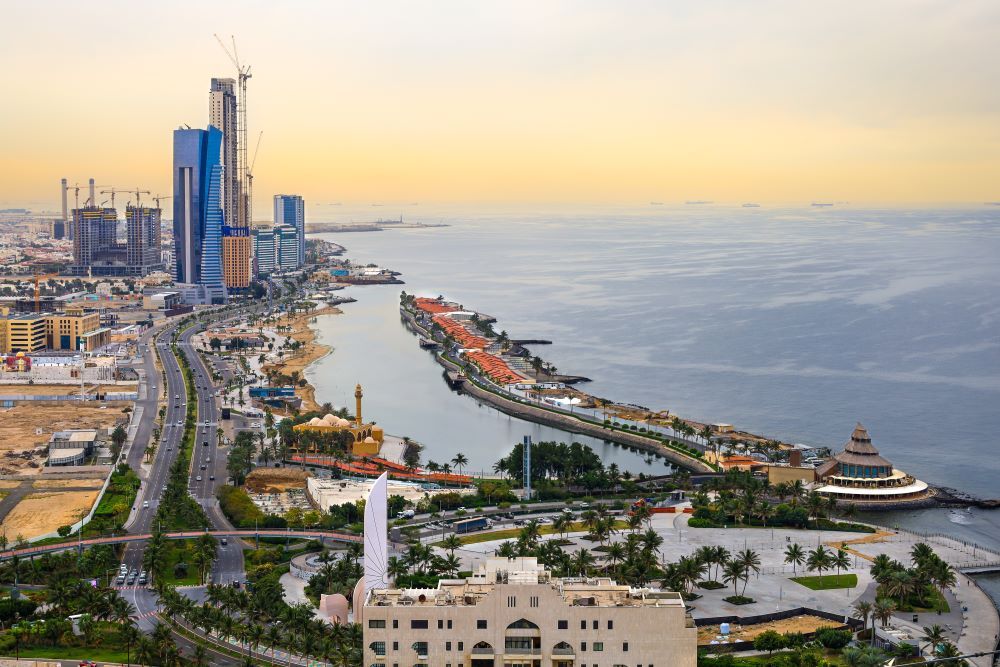
The Corniche is the city's defining public gesture. This sweeping coastal promenade stretches more than 30 kilometres along the Red Sea, lined with gardens, sculptures, waterfront restaurants and open sea views. In the early mornings and long golden evenings for which the city is best experienced, it is animated in a way that few urban waterfronts in the region can match. The Red Sea itself, one of the world's most celebrated diving destinations, offers extraordinary marine access almost entirely on Jeddah's doorstep and draw enthusiasts from across the globe.
Beaches, both public and private, extend along the northern coastline and within resort developments expanding rapidly as tourism infrastructure matures. Jeddah Central's planned 2.1-kilometre sandy beach will add a significant new focal point to this coastal offer, integrating beach access directly with a world-class residential and hospitality district in a manner more typically associated with Miami or the French Riviera than the Arabian Gulf.
A Cultural Capital’s Coming of Age
Alongside its coastal character, Jeddah has assembled a cultural identity of genuine international standing, and it is this combination that makes the city truly distinctive within the region.
Hayy Jameel, Saudi Arabia's dedicated arts complex and creative hub, has become the city's cultural anchor, drawing artists, curators and audiences into a programme of visual arts, film, design and creative exchange that feels neither performative nor provisional. It is a serious institution in a city that has earned the right to one.
The Red Sea International Film Festival has added a further dimension of global visibility. Launched in 2019 and growing in stature with each annual edition, the festival has positioned Jeddah on the international cinematic map, attracting filmmakers, producers and industry figures from across the world to a city that embraces rather than merely observes contemporary creative culture. For the internationally minded buyer, an event of this calibre signals something important: this is a city with the cultural metabolism to sustain the lifestyle expectations of a global resident.
Jeddah's music scene is evolving at a comparable pace. Major international concerts and live events were once absent from Saudi Arabia's cultural calendar entirely, but are now a regular feature of the city's social life. They draw both regional and international artists, consolidating Jeddah's reputation as the Kingdom's most outward-facing and culturally permissive urban environment. The energy this generates is felt not only at the events themselves, but in the restaurants, galleries and gathering places that surround them which form the connective tissue of a city coming fully into its own.
The revitalisation of Al Balad, the city's UNESCO-listed historic district, grounds all of this in something irreplaceable. Where many cities must manufacture heritage, Jeddah's is architectural, inscribed in the coral-stone facades and carved wooden mashrabiya screens of its old trading quarter. As Al Balad continues its careful evolution into a destination for culture, dining and heritage hospitality, it reinforces the city's long-term appeal as a place with enduring identity.
The Rise of Branded Residential Living
For the international buyer seeking premium exposure to Jeddah's trajectory, the branded residential market offers one of the most compelling entry points. The Four Seasons Private Residences on the Corniche and Raffles Jeddah on the waterfront already provide globally recognisable anchors for luxury living in the city. Within Jeddah Central, the future Mandarin Oriental will extend this ecosystem further, embedding five-star service standards and an internationally legible management proposition into the heart of the new waterfront district.
These developments do more than lend prestige to individual addresses. They shift the entire conversation, from simply acquiring property to entering a managed luxury ecosystem with clear standards of quality, service and international marketability. This builds immense value for investors who are seeking long-term appreciation, and also provides a secure residential option for end-users who may want to settle into the Kingdom for a while.
Connectivity as a Multiplier
No analysis of Jeddah would be complete without addressing connectivity. King Abdulaziz International Airport serves as the primary entry point for millions of pilgrims travelling to Makkah annually, alongside a fast-growing leisure and business travel base. The city's historic role as a port, and its continued function as one, reinforces its position at the intersection of regional and international movement.
In real estate terms, this translates directly into demand. Cities through which people pass, and to which people return, sustain residential markets with a resilience that more isolated locations cannot match. Jeddah's combination of pilgrimage proximity, business relevance and growing tourism infrastructure creates a multiplier effect that underpins long-term capital performance.
Why the Long-Term Case Is Strong
Jeddah is an established city that is commercially substantive, culturally layered and geographically irreplaceable. And now, it is entering a more deliberately curated phase of residential and lifestyle evolution. Regulatory reform under Vision 2030, sovereign capital deployment at scale, and a maturing branded residential market are sharpening a proposition that was already credible.
For investors seeking exposure to Saudi Arabia's longer arc of urban and economic development, the entry through a city of Jeddah's character carries a different quality of conviction than a greenfield bet. It already has an established identity and is bolstering the infrastructure to support it. In a region where many locations are still finding their voice, Jeddah already knows who it is. That is, in the end, the strongest investment thesis of all.
To get a a better understanding of Jeddah’s evolving landscape and its most notable residential developments, reach out to the team at Saudi Arabia Sotheby’s International Realty: the Kingdom’s foremost authority on prime and super prime real estate.